Saturday, March 31, 2007
Follow the Money III
According to Jacob Goldstein of The WSJ Health Blog federal investigators are looking into possible conflicts of interest for over 100 National Institute Of Health Scientists with financial ties to larger pharmaceutical companies details are here.


The Health Care Blog
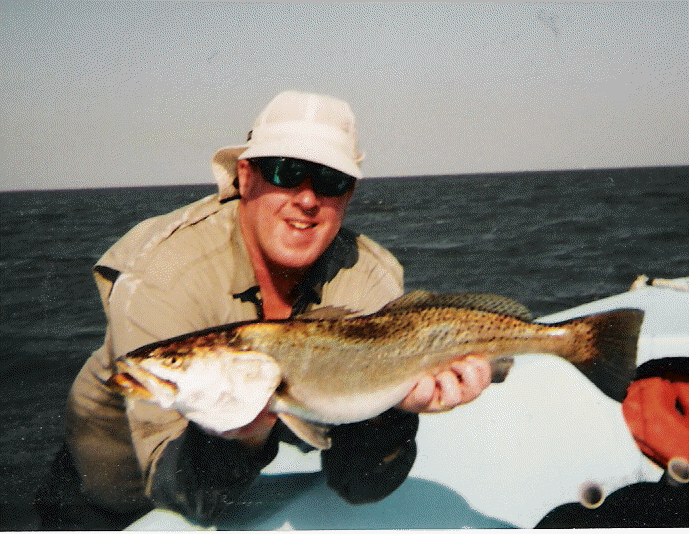
Matthew Holt at The Health Care Blog was gracious in giving this site a plug last week and in complimenting me on my personal best speckled trout (photo at bottom of the page). Actually, I received numerous email comments on the trout proving there are many others out there just like me who would rather be fishing.
If you have not checked out THCB please do so as you will find the blog rich in great content.
If you have not checked out THCB please do so as you will find the blog rich in great content.
Someone is going to Pay For These Promises
The WSJ Health Blog reported yesterday in a post by Theo Francis that US State and Federal promises to retirees for Health Care and other Benefits carry a price tag of $1.5 Trillion according to a report by Credit Suisse which you can find here. The Government Accounting Standards Board recently enacted new rules which happen to mirror changes enacted in the private sector well over 15 years ago by FASB when FAS 106 & 112 obligated GAAP accounting rules to account for retiree health care and benefit obligations.
Those of us with a little gray hair saw this movie play out in the private sector with FAS 106 & 112 so its funny to envision the staff at The WSJ Health Blog being shocked by the magnitude of the obligation retiree health care represents. While there is some humor in seeing the government live by the same rules as the private sector it should be short-lived if you are a taxpayer so don't get carried away.
For the record let me say that I followed closely Theo Francis stories of Elliot Spitzer's investigations of the use of contingency commissions and overrides by insurer's in the WSJ several years ago and thought it was first rate so forgive my chuckle over the aha moment when the magnitude of the retiree obligations got revealed. Didn't your dad laugh at you the first time you got a paycheck and complained about all the taxes they took out?
Those of us with a little gray hair saw this movie play out in the private sector with FAS 106 & 112 so its funny to envision the staff at The WSJ Health Blog being shocked by the magnitude of the obligation retiree health care represents. While there is some humor in seeing the government live by the same rules as the private sector it should be short-lived if you are a taxpayer so don't get carried away.
You can check out the map in the Credit Suisse Report to see how your state taxes will be impacted.The upshot is that health-care costs for state and municipal retirees will drain public coffers, sparking either huge tax-hikes or spending cuts.
For the record let me say that I followed closely Theo Francis stories of Elliot Spitzer's investigations of the use of contingency commissions and overrides by insurer's in the WSJ several years ago and thought it was first rate so forgive my chuckle over the aha moment when the magnitude of the retiree obligations got revealed. Didn't your dad laugh at you the first time you got a paycheck and complained about all the taxes they took out?
Friday, March 30, 2007
The Answer is Blowing In The Wind
Great summary from Roy Blount, III at Health Plan Law on the implications of Fraud Lawsuits against Pharamaceutical Companies for Health Care Reform here.
Throw in a presidential election year, the volatility of seniors discovering their Medicare dough nut hole and 2008 could see the brushfire threaten the ammo dump that is the pharma-industrial complex not to mention the powder keg of health care reform in the employer sector as Hillarycare II gets under way. There are Santa Ana winds heading for this little brushfire.
In this recent opinion, the district court denied the defendants’ motion to dismiss, thus permitting the plaintiff-relator’s case to go forward on all but one count of California’s False Claims Act. This case serves to illustrate several points.
First, it provides an overview of how state False Claims Act statutes may be employed to challenge costs imposed on Medicaid programs.
Second, the case serves as an object example of why specific attention to pharmaceutical company business practices must be a central component of any serious health care reform proposal.
Third, the case sheds light on the often clandestine profit vectors associated with the sale of pharmaceuticals.
Throw in a presidential election year, the volatility of seniors discovering their Medicare dough nut hole and 2008 could see the brushfire threaten the ammo dump that is the pharma-industrial complex not to mention the powder keg of health care reform in the employer sector as Hillarycare II gets under way. There are Santa Ana winds heading for this little brushfire.
A Picture is Worth a Thousand Words
John Mack at Pharma Marketing Blog has a seriously funny post today about observing drug reps in their natural environment which you can find here.
Next time you are waiting at the doctors office skip the Newsweek and observe what is really happening. After you are done observing think about the impact what you just saw is having on your drug spend as a benefit manager. See, its research. Its business. Kudos to John for pointing out this gem published in Time Magazine where a male doctor talks candidly about the joys of interacting with "Pharma Babes"
Next time you are waiting at the doctors office skip the Newsweek and observe what is really happening. After you are done observing think about the impact what you just saw is having on your drug spend as a benefit manager. See, its research. Its business. Kudos to John for pointing out this gem published in Time Magazine where a male doctor talks candidly about the joys of interacting with "Pharma Babes"
It's the click of high heels that gets our attention. The hospital is a place of aching feet in wide, thick rubber-bottomed, stand-all-day-long shoes. And our good women thus shod can't compete; in the weary, unaesthetic world of sick people they work too hard at tasks that are too unglamorous. Those good women were the first to warn us about the young lovelies in high heels. But the pharma babes still get to us, and the good women just roll their eyes. Younger and prettier — or at least better coiffed than anybody taking actual care of the sick — drug reps are a feature of medical life that few outsiders see. Known as "detail" people or (behind closed doors) "pharma babes,"
Surveillance exposes Disability Fraud-Black Hole II
Chalk one up for the good guys. As you read this stop and ponder what happens when behavior like this becomes engrained in a company's culture. Hat tip to BenefitsLink which has a great aggregation service for the story here.
STD Cost $15,000 per claim X 30 claims = $450,000 in direct costs
LTD cost of $30,000 per claim X 30 claims= $900,000 in direct costs
Total Direct Costs = $1.350,000 annually
A refinery must be efficient to drive profits but for the sake of argument lets low ball the productivity ROI and call it a 2-1 return on labor costs.
Total Indirect Costs = $2,700,000 annually
Total Direct and Indirect Cost of STD Fraud equals $4,050,000 annually.
Notice we have not even included costs for over-time or excess staffing but these are very real for an employer in this predicament. Welcome to the black hole, that giant sucking sound you hear is the black hole of STD (see earlier post by The Group Guy) crushing your benefits and payroll budget. Fraud--a little goes a long way.
The good news is I have solved this very problem at numerous companies large and small.
Now stop and ponder what happens when behavior like this is becomes part of your culture and word spreads. If your firm has 3000 employees and 1% behave this way each and every year what is the economic impact. Lets do the math and assume a $50,000 annual salary (low for a refinery) and 60% STD and LTD plans with a 6 month STD benefit period and followed by LTD.Employee On Short Term Disability Terminated Based On Video Surveillance
from Spencer’s Benefits Reports: An employer did not violate ERISA when it terminated an employee on disability leave based upon surveillance showing the employee engaging in physical activities beyond his supposed disabilities. This was the decision of the Tenth Circuit U.S. Court of Appeals in Denham v. Sunoco, Inc. (No. 06-5040).
John M. Denham worked at Sunoco’s lubricants refinery in Tulsa, Okla. On May 25, 2000, Mr. Denham began a medical leave of absence due to neck, shoulder, and back ailments, and he began receiving short term disability benefits under Sunoco’s disability income plan. As required by company policy, Mr. Denham periodically reported his medical condition to his supervisor and to Sunoco’s company physician at the Tulsa refinery, Dr. Campbell. Mr. Denham also gave consent for his medical records to be shared with Sunoco.
During the time that Mr. Denham was on disability leave, his supervisor heard comments from other Sunoco employees indicating that Mr. Denham might have been engaging in physical activities apparently incompatible with his disabilities. In order to verify these rumors, Sunoco hired a private investigative agency to look into the matter. Rex Merritt, a local investigator experienced in surveillance work, then followed Mr. Denham and videotaped his activities. Mr. Merritt submitted a videotape to Sunoco’s human resources department showing Mr. Denham working on a truck, making a trip to a local auto-supply store, and unloading 50-pound sacks. On Nov. 15, 2000, Mr. Denham was summoned to Sunoco’s HR department, where the videotape was shown to Mr. Denham, Dr. Campbell, and other HR personnel. After Dr. Campbell concluded that Mr. Denham could not have been performing the activities shown on the videotape with his claimed impairments, Sunoco terminated Mr. Denham’s employment.
STD Cost $15,000 per claim X 30 claims = $450,000 in direct costs
LTD cost of $30,000 per claim X 30 claims= $900,000 in direct costs
Total Direct Costs = $1.350,000 annually
A refinery must be efficient to drive profits but for the sake of argument lets low ball the productivity ROI and call it a 2-1 return on labor costs.
Total Indirect Costs = $2,700,000 annually
Total Direct and Indirect Cost of STD Fraud equals $4,050,000 annually.
Notice we have not even included costs for over-time or excess staffing but these are very real for an employer in this predicament. Welcome to the black hole, that giant sucking sound you hear is the black hole of STD (see earlier post by The Group Guy) crushing your benefits and payroll budget. Fraud--a little goes a long way.
The good news is I have solved this very problem at numerous companies large and small.
Thursday, March 29, 2007
Pharmaceutical Trade Secrets Revealed
Despite state laws requiring disclosure of payments made by pharmaceutical companies to physicians in 5 states and the District of Columbia, very little information about who receives and in what amounts is actually revealed according to Reuters reporting on a study in The Journal of The American Medical Association. Two states, Vermont and Minnesota require disclosure to the public.
A study by a professor at UCLA medical school found physicians only discussed costs, co-pays, re-fills, insurance and money saving alternatives 1/3 of the time with their patients. The patients only ask questions 2% of the time of their doctors on these subjects. The study notes patients need to engage their doctors with questions about the low cost alternatives and many of the patients on multiple medications for chronic conditions cannot afford to comply with their maintenance drugs.
But those trade secrets being discussed between pharmaceutical manufacturers and physicians so proprietary they result in payments never do seem to translate into conversations with patients about the available drug options 2/3 of the time. Think about that for a minute, no make it two minutes. This is precisely how formulary driven PBMS drive serious Profit.
So here in a nutshell is the trade secret revealed for the entire pharma-PBM industry for the very first time; patients do not ask about cost and doctors do not tell. There is nothing insidious this is a product of behavior which can change with the appropriate incentives. The good news is this problem is fixable for employers by plan design (going to $0 co-pay for low cost in class generics) and a cost + administrative fee PBM model that has no price spreads on generics, no rebates and an evidence based formulary. Many insured(see link to BCBS no-pay co-pay) and self-funded plans plans with a good group guy have already figured this stuff out.
This post is not intended to disparage physicians only to reveal how behavior produces the results which will create nuclear fallout by the 2008 election as the entire population of the US capable of sentient thought will know a dough-nut hole is found in Medicare not a bakery. If you think healthcare is expensive now just wait until John Edwards or Hillary Clinton make it free.
The analysis included data from January 2002 to December 2004 in Minnesota and from July 2003 to June 2004 in Vermont.
The researchers found that obtaining the payment information was not easy. In Vermont, extensive negotiation with the Office of the Attorney General was needed, while in Minnesota, manual photocopying of individual disclosure forms at the State Board of Pharmacy was required.
Missing disclosure information was common in both states.
In Vermont, 61% of payments were not released to the public because the drug companies classified them as revealing trade secrets and 75% of disclosed payments lacked information to identify the recipient.
A study by a professor at UCLA medical school found physicians only discussed costs, co-pays, re-fills, insurance and money saving alternatives 1/3 of the time with their patients. The patients only ask questions 2% of the time of their doctors on these subjects. The study notes patients need to engage their doctors with questions about the low cost alternatives and many of the patients on multiple medications for chronic conditions cannot afford to comply with their maintenance drugs.
But those trade secrets being discussed between pharmaceutical manufacturers and physicians so proprietary they result in payments never do seem to translate into conversations with patients about the available drug options 2/3 of the time. Think about that for a minute, no make it two minutes. This is precisely how formulary driven PBMS drive serious Profit.
So here in a nutshell is the trade secret revealed for the entire pharma-PBM industry for the very first time; patients do not ask about cost and doctors do not tell. There is nothing insidious this is a product of behavior which can change with the appropriate incentives. The good news is this problem is fixable for employers by plan design (going to $0 co-pay for low cost in class generics) and a cost + administrative fee PBM model that has no price spreads on generics, no rebates and an evidence based formulary. Many insured(see link to BCBS no-pay co-pay) and self-funded plans plans with a good group guy have already figured this stuff out.
This post is not intended to disparage physicians only to reveal how behavior produces the results which will create nuclear fallout by the 2008 election as the entire population of the US capable of sentient thought will know a dough-nut hole is found in Medicare not a bakery. If you think healthcare is expensive now just wait until John Edwards or Hillary Clinton make it free.
Subscribe to:
Posts (Atom)